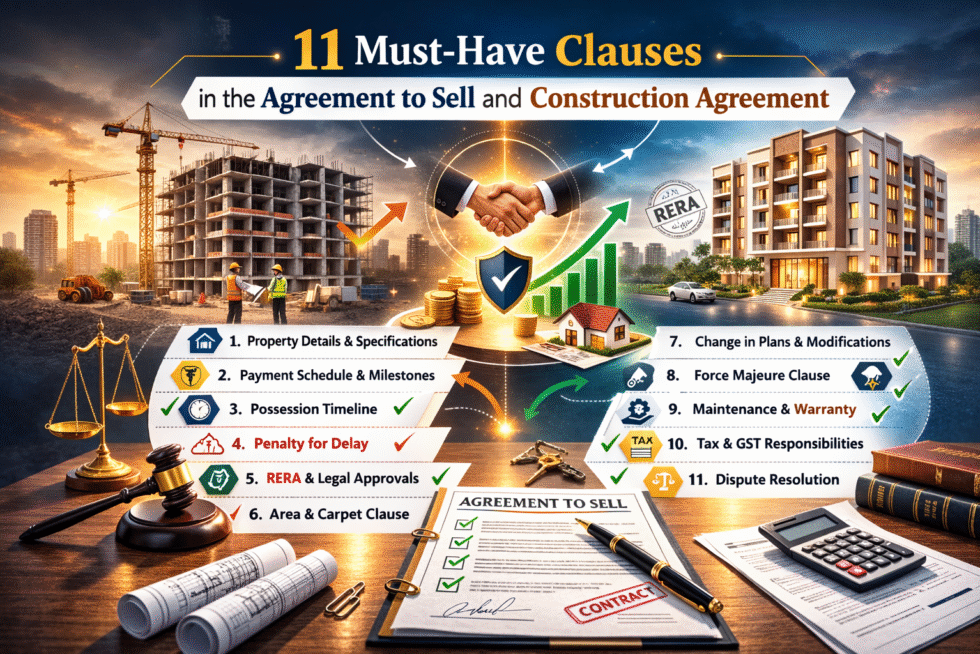
After crossing the hurdle of identifying the property you intend to buy, the next herculean task is to make sure that your investment goes through the most systematic and channelized way, so that you not only safeguard your investment but also secure future interest arising out of the property.
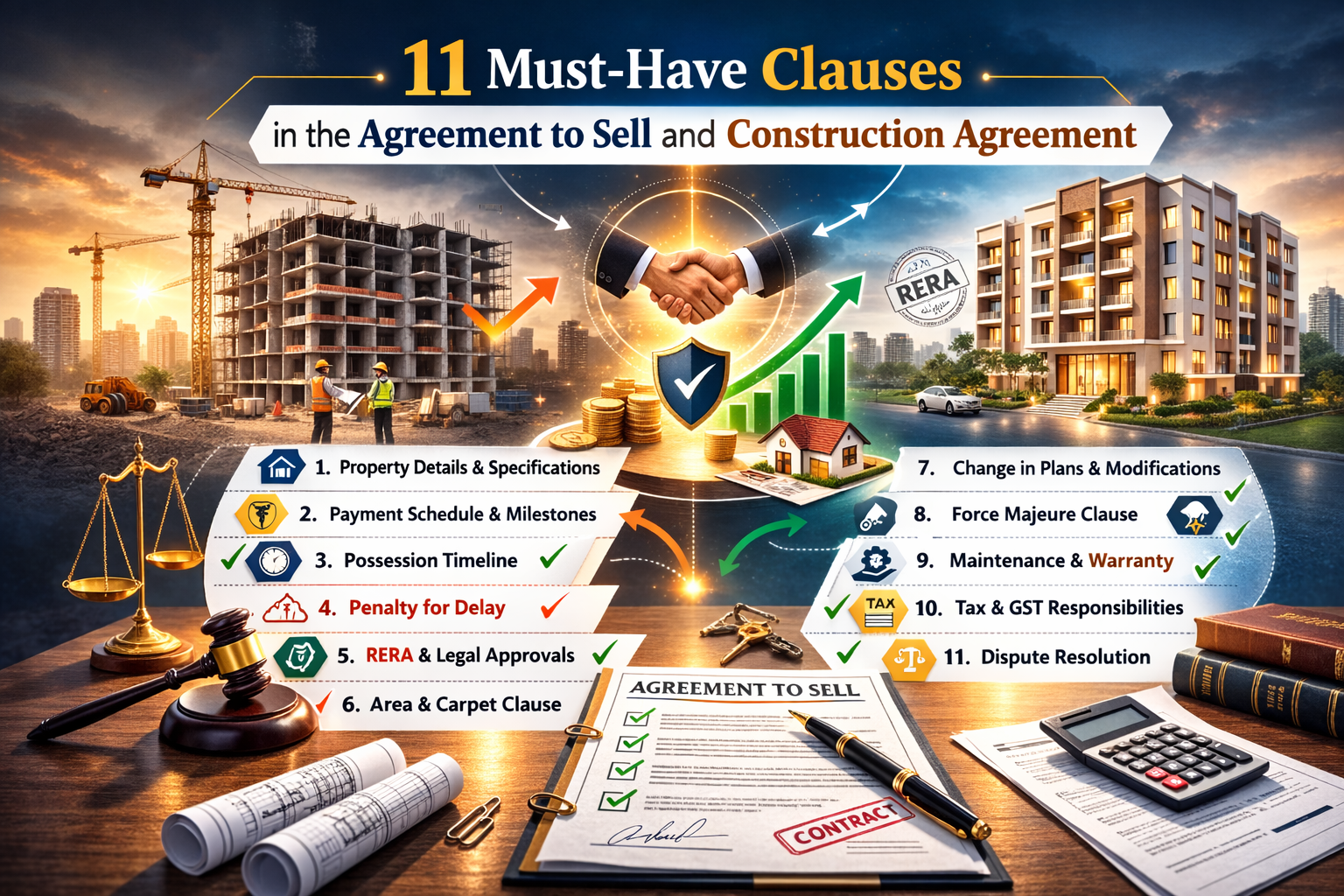
Always remember when you pay the advances towards the property, foremost thing you need to get into is the agreement to sell with the seller wherein you pay stamp duty as applicable for your state, and record the total consideration and advances agreed to be paid for the property. If it’s an under construction property and you are buying directly from the builder, the builder may ask you to sign two documents i.e. Agreement to Sell and Construction Agreement, which means that you agree with the terms and conditions set out there. However, it is the general trend that most of us don’t read the documents careful or rather don’t know which are those essential clauses which need to be specifically looked into.
So here’s an insight of those clauses:
Under Agreement to Sell and the Construction Agreement:
(1) Consideration: Consideration amount is the total price on which you the buyer has agreed to purchase the property from the seller, which will basically be the actual market value along with the extra charges such as charges to be paid towards water and sewage, electricity, transformer, cable accessories, sales tax, service tax, water contract tax, VAT, registration charges, maintenance, membership, corpus fund etc. Out of these extra charges it is crucial to identify that which of these are included in the consideration and how much extra cost you need to bear, which will help you in identifying any hidden cost involved in the process.
(2) Delivery of Possession: Get the clarity on the date of delivery of possession, which needs to be recorded in the Agreement, further look out for the clause which captures penalty on account of delay on the part of the builder.
It is pertinent to mention that as per the Real Estate (Development & Regulation) Act, 2016 (the Real Estate Act), ensures that the penalty fixed by the builder for delay in making the payment should be equivalent to the penalty to be imposed on the builder, henceforth, compare the penalties for both the conditions, before signing the Agreement.
If you are buying the property from the seller and it’s a second sale, then you need to fix on the time line for execution of the sale deed execution and registration.
(3) Penalty, forfeiture clauses in case of default and termination clauses: The buyer needs to carefully read this clause which records the penalties in case of default in payment, the builder can also terminate and forfeit money advanced towards the property, therefore you need to negotiate and agree on those terms which sounds reasonable. Upon termination the standard terms defined by the builder are that “they would refund the amount within one month from the date of resale of the Property”, which is again something needs to be exhaustively negotiated, the effect of such type of condition will make your investment/money dead, it is called dead as no interest will be accruing till the time it is refunded.
(4) Indemnity Clause: This clause shall protect the buyer from the losses which the buyer has to bear or to be born on account of unwanted third party claims, any recovery proceeding or court order, cess, charges etc. imposed on the property due to negligence on the part of the builder or the seller.
(5) Condition Precedents to be recorded in a separate clauses: There are lots of terms which the builder promises to comply before or at the time of execution of the sale deed, it is always advisable to record it under the Agreement, so that compliance of all the terms becomes binding on the builder. For instance, the builder may have assured to furnish Occupancy Certificate or to pay the betterment charges or to obtain khatha/mutation document or to resolve certain issues relating to the title of the property, in absence of any written undertaking by the builder, it is difficult to get these terms enforced when the builder, on account of the builder failing to hold its promise.
One more scenario, if it’s a completed property and given on lease by the seller, you need to specifically clarify in the Agreement whether you require the tenants to move out or you would like the tenancy to continue and accrue to the benefits arising out of the property.
(6) Specific Performance and Arbitration Clause: In case any of the party is not willing to fulfil his part of contract by not coming forward to execute the Sale Deed or has committed breach of any of the conditions enumerated in the Agreement, then the other party can approach the Civil Court to make those terms binding or if there is a provision to appoint Arbitrator, the Arbitrator can be appointed, he shall resolve the issues by mutual consent and discussion.
(7) Representations and warranties given by the Builder/Seller: Look out for the clause wherein the builder or the seller give its warranties as related to their absolute ownership and actual possession over the property, payment of upto date property taxes, free from any encumbrance, charges or adverse statutory proceedings.
(8) Property Description: Verify all the details related to the property are captured accurately, i.e. property number, extent, super built up area, carpet area, undivided share, car park, exclusive terrace area, project name, location etc.
Additional Clauses under the Construction Agreement:
(9) Defect Liability Clause: The Real Estate Act has made it mandatory for the builder to protect the buyer from any structural defect on the property for a period of five years, in case you find the term mentioned in your agreement is less than that then it is a time for you to remind the builder of his obligations under the Act. Further, always check from which date is the defect liability clause will get started, the best term shall be from the date of possession delivered.
(10) Specifications: Read the specifically carefully as that would determine the quality and standard of the construction, if there is any compromise to the quality, it amounts to breach of the terms in the Agreement, which can be specifically enforced as described above.
(11) Payment Schedule: The important aspect to record again in the Agreement is the Payment schedule, if there is any deviation you find which differs to the terms orally agreed, can be flagged out before given written consent to the same.