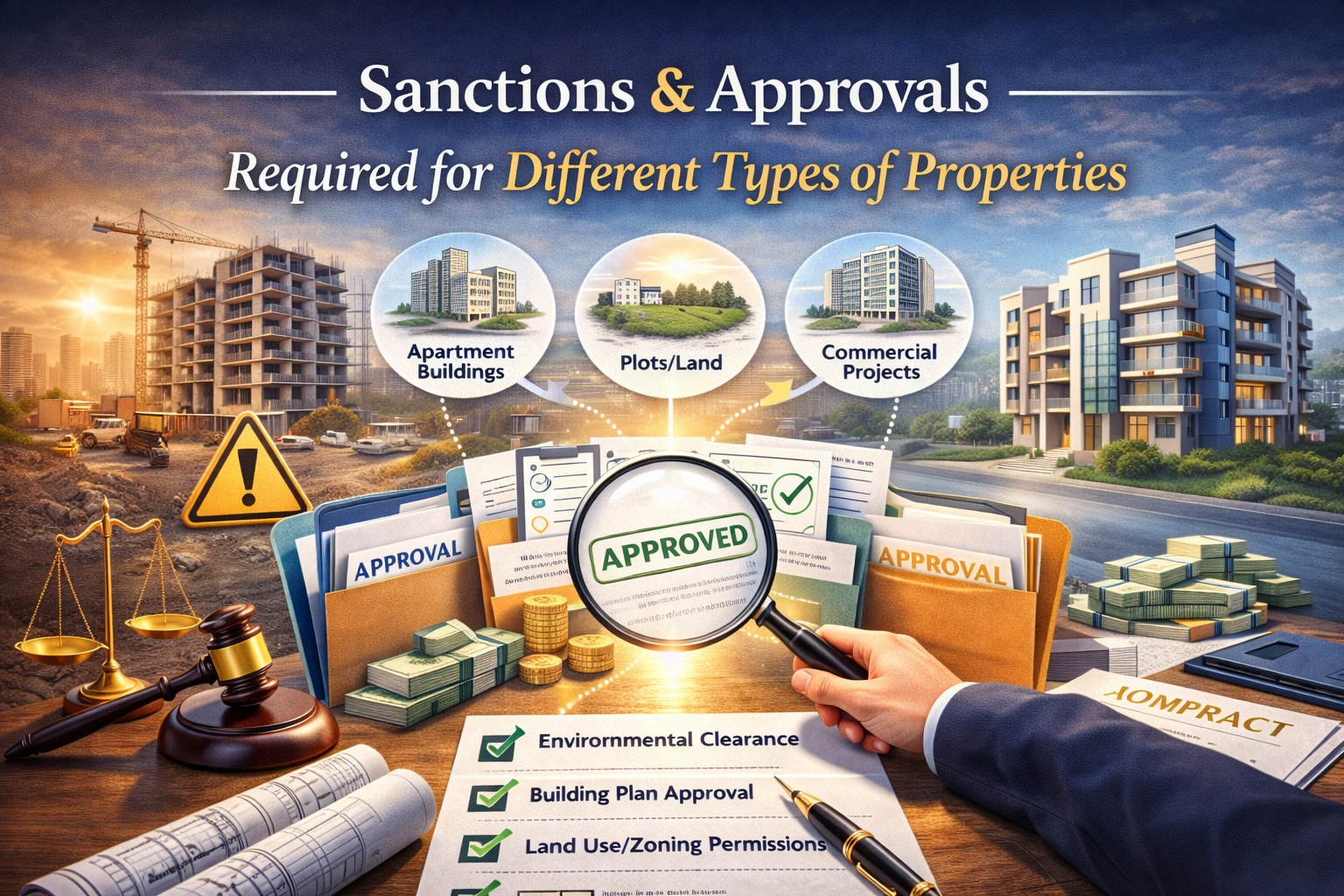
The ‘real estate sector’ is one of the most globally recognized booming sector, which helps in economic growth. Real estate offers good opportunity for investment, where you can earn good profits. There is a huge demand in the residential sector, and in order to meet the demands and attract the customer, the builders often come up with different types of lucrative offers.
Before blindly going by the offers, be vigilant enough to evaluate the Property from the construction stand point. In this article we have covered the sanctions and approvals required for three types of properties i.e. Apartment, Villa and Independent House at both pre construction and post construction phase.
For Apartments:
For the property type such as apartment, the approval and the sanctions vary depending upon the building size, if it is a high rise apartment building, the permissions and statutory compliances are more as compared to the regular buildings. So we have categorized the building into two types as according to the National Building Code of India, 2005, which is being followed in most of the states in India, you would find this common distinction:
- High Rise Buildings [Above Ground Floor plus Three Floors or (15 meters height)]
- Not High Rise Buildings or Regular Building [Less Than or equal to Ground Floor plus Three Floors or (15 meters height)]
Sanctioned Building Plan:
The minimum document requirement for both the categories at pre and post construction will be Sanctioned Building Plan issued by the jurisdictional planning authority, denoting the number of floors approved for the construction. The most crucial point needs to be factored is whether the particular Apartment you plan to buy has the sanctions or not.
Recently, Greater Noida Industrial Development Authority (GNIDA) has asked one of the prominent builder Supertech in Noida to seal more than 1000 flats and Villas in Sector Omicron-1, Greater Noida for large scale violation of the sanctioned building plan.
The Mumbai’s Camp Cola Compound has also remained in lime light in past years, there also the builder had permission to construct only 6 floors, they constructed 35 more floor, the Bombay Municipal Corporation did not issue any Occupancy Certificate for the Building and in turn issued notice for its demolition. The matter went to Bombay High Court where eviction and demotion of the Building was confirmed, which was appealed by the Apartment Association to the Supreme Court, wherein the relief was granted to the residents to allow representation to the State Government for regularisation, which is still pending for consideration.
Any violation on the sanctioned plan, largely effects the resident who has invested on the Apartment, as the Builder who violated has already sold most of the apartments and is not effected at large. The burden of fighting the legal battle is on the residents who makes all the possible effort to save their hard earned money.
No Objection Certificate (NOC):
(A) For any building to be constructed, it is obligatory for the Builder to obtain the approvals from the local authorities and departments such as
- NOC from State Pollution Control Board
- NOC from Electricity Board such as BESCOM in Karnataka, DPCL, BRPL in Delhi etc.
- NOC from Water Supply and Sewage Board – For high rises apartments, builders will have to meet around 24 conditions, including sewage treatment plants for apartments with over 100 units and rainwater harvesting facilities
(B) Apart from the above list, for the high rise building, the builder needs to apply for other NOC’s for the height clearance. i.e,
- NOC from Airports Authority of India (AAI)
- NOC from Bharat Sanchar Nigam Limited (BSNL) or MTNL in Mumbai.
- NOC from Fire and Emergency Department
- NOC from State Environment Impact Assessment Authority. (SEIAA)
(C) There are few NOC’s which are restricted to state and city for instance in Delhi and Mumbai, where more of the heritage and monuments are present.
- NOC from National Monument Authority
- NOC from Mumbai Heritage Conservation Committee
(D) The Cities where the metros are running or proposed to be developed
- NOC from Metro Rail Corporation
(E) The Cities near the costal regions:
- NOC from Costal Zone Management Authority
The Supreme Court has time and again directed the concerned authorities to take necessary actions against the Builders and imposed penalty on them, who have violated the norms for construction and not obtained necessary NOC’s from various department. Such violation has not only damaged the ecology and environment but also impacted the planned development of the city, further the regularisation of such buildings has worsen the situation, refer to the Supreme Court judgement in Esha Ekta Apartment Co-operative House Society Limited and others versus Muncipal Corporation of Mumbai and others.
Recently in Forward Foundation and others versus State of Karnataka and others the National Green Tribunal has delivered the land mark judgement wherein proper environment clerances were not taken before commencement of the project, which in turn caused hazard to the environment.
Commencement Certificate (CC):
Commencement Certificate is a document which is issued by the concerned authority who has sanctioned the building plan. The Builder is required to obtain this document at the beginning of the construction, upon submitting the application and the required consents from the local authorities subject to the local laws of each state. The procurement of the CC at the initial stage of construction is in itself evidentiary to prove that the construction is in compliance with the building bye laws and norms.
Occupancy Certificate (OC)
As mentioned above, after getting a Sanctioned Building Plan, construction starts. When it is ready to be occupied, again the local planning authorities issue a certificate commonly called Occupancy Certificate (OC) or in some states referred as the Completion Certificate. This implies that the construction was carried out in compliance with the building plans and the norms, and is ready to be occupied.
For Villas and Independent House :
For the Property Type Villa and Independent House, the sanctions and approvals will be same as listed for the Regular building type discussed under Apartment.
In addition to that, Villa will require some more approvals:
Sanctioned Layout Plan:
Any piece of land which is sub-divided by metes and bounds into independent sites needs to take requisite permission from the relevant authority by way of an approved layout plan with the seal and signature of the issuing authority. The approved layout plan identifies the exact location and dimension of the Site. Absence of this document will bring your property in the category of illegal and unauthorized Villa.
Release Order:
In the State of Karnataka, when a layout is formed within the jurisdictional planning authorities such as BIAAPA, BMRDA, BDA, etc., as per the Rules governing these bodies, it is mandatory for the developer to surrender 40% of the to be developed land and is only authorized to sell 60% of the land, henceforth, if the layout plan is developed in consonance with the norms laid down for the development, then the concerned authority shall issue the Release Order (post construction) granting permission to sell the remaining 40% of the developed land.