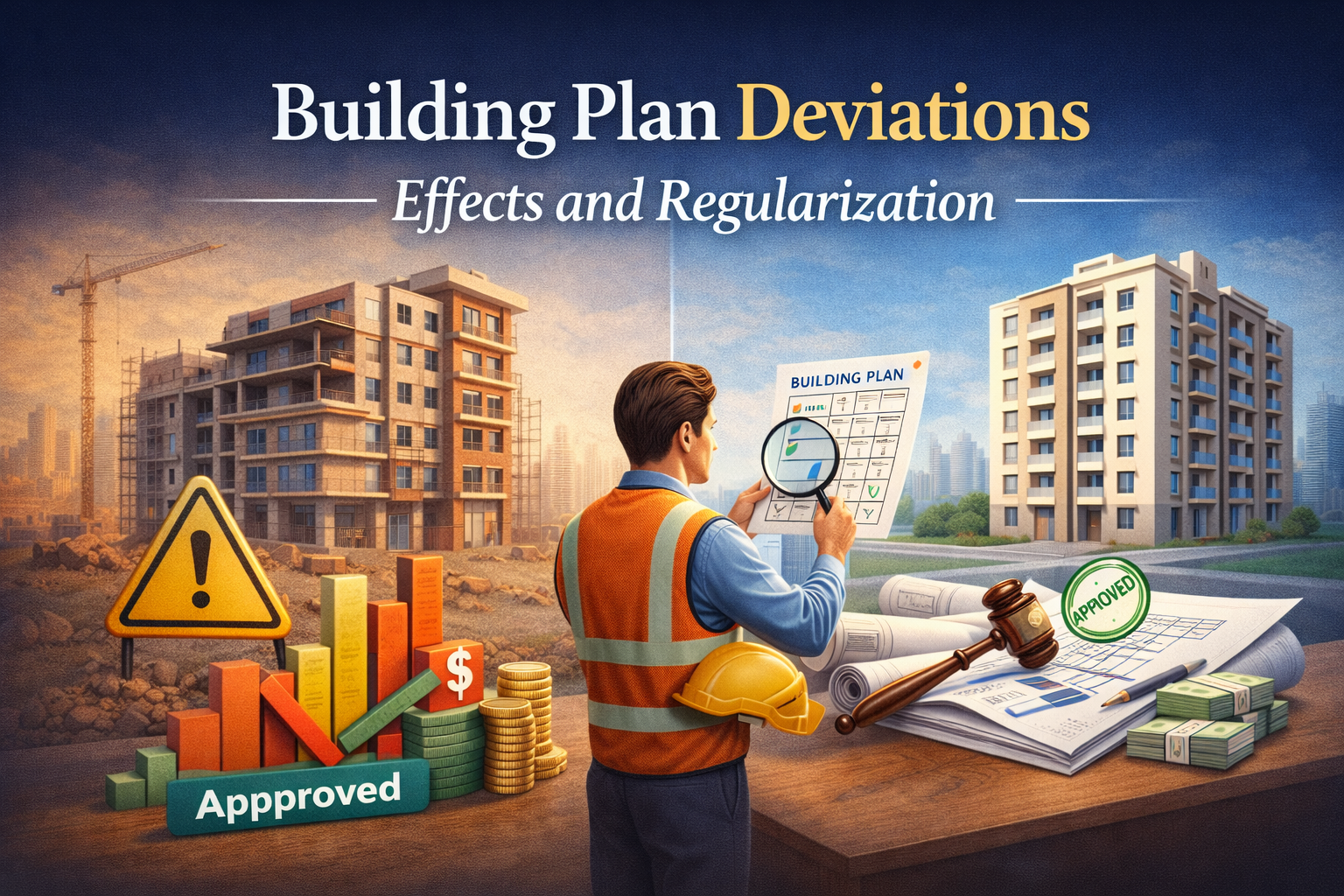
Refer to our earlier blog “Sanctions required for other types of Properties“, where we have discussed various sanctions, approvals and NOC’s required for different types of properties. In this blog, we will evaluate certain essential conditions imposed on sanctions; the permissible limit for deviations and its regularisation process.
Let’s look at some of those conditions on the sanctions:
- If the use of the building is permitted for residential use only, then not to deviate to any other use;
- Basement of the building to be reserved only for parking;
- Permission to be obtained from forest department for cutting trees;
- To strictly adhere to the building bye laws and National Building Code;
- To strictly abide by the specification and layout of the building plan;
- Commencement Certificate to be obtained on completion of foundation and before erection of walls;
- Construction to be completed within the time frame specified in the licence;
- The building should not be occupied without obtaining Occupancy Certificate;
- Rain Water Harvesting Structures to be provided and maintained for storage of water and recharge of ground water at all times;
- Solar water heaters to be provided;
- Garbage segregation into organic and inorganic waste; and recycling processing unit to be installed at the site for its re-use/disposal.
- For high rise building, to obtain clearance certificate from Fire Force Department;
- To submit NOC from State Pollution Control Board, Water Supply and Sewage Board, Electricity Supply Board, and State Environment Impact Assessment Board before obtaining Commencement Certificate.
(1) What are the permissible limits for deviation of the Sanctioned Plan:
If there is a deviation in construction from the sanctioned building plan within the limits of five percent (5%) of:
- the set back to be provided around the building
- plot coverage
- floor area ratio and
- height of the building
such deviation or violation is permitted upon payment of regularisation fees, only on the condition that it does not effect the structural stability of the building as prescribed in the building bye laws applicable for the place.
(2) Consequence of deviations beyond the permissible limits:
- Difficult to obtain Occupancy and Completion Certificate – If the deviation is more than five percent (5%) from the approved building plan, then the Occupancy Certificate will not be issued. Unless there is an Occupancy Certificate for the building, it is illegal to occupy it.
- Hurdle faced while availing loan – If there is a major deviation in the project, the banks will not agree to grant loans for such building as a consequence the property owner will face problem at the time of selling the property. Difficulty in getting the loan sanction will attract less buyers, which may in most likelihood will be less profitable deal as the property owner will be compelled to sell off the property at heavy discounted price.
- Threat of demolition of building – If the deviation is more than the permissible limits and is not being regularised by the Development Authority, then in such a scenario the property owner will be under the threat of it being demolished, as per the applicable provisions of building bye laws, such deviations may be ordered for demolition.
- Liable to penalty – Any deviation in the construction from the sanctioned plan if it is regularised, then the property owner/builder is liable to the penalties as provided under the applicable laws.
- Possibility of getting B Extract instead of A Khata – In Bangalore, for obtaining Khatha Certificate, it is crucial that the building complies with the statutory norms, if there is a deviation which is not regularised then there is possibility of getting B Extract instead of A Khata which may in turn effect the owner in getting marketable title over the property.
(3) Can deviation be regularised:
Certain States like Karnataka, have the provision for regularizing subject to such restriction and on payment of prescribed fees. For instance under the Karnataka Municipal Corporation Act, 1976, empowers the Commissioner to regularize building constructed prior to certain cut-off date, again restrictions being imposed i.e. on the set back area; relating to building lines etc.
(4) Regularisation not applicable:
Regularisation is not applicable for those deviations where the building plan is not obtained for construction. Further, in case the deviations are already rejected in the sanctioned plan such deviations will not be regularised.