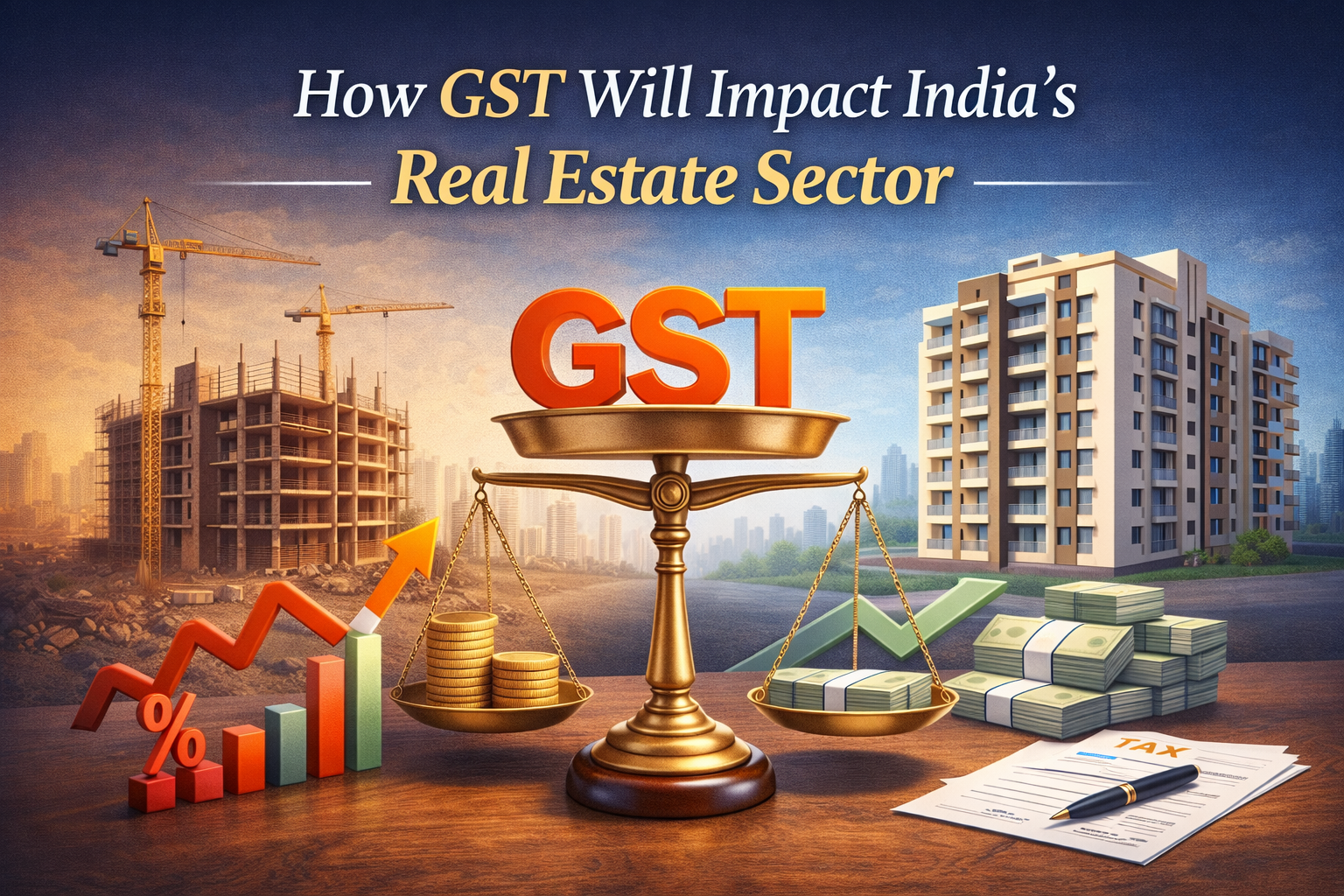
After a long period of being plagued with uncertainties, it seems the real estate industry in India is at the cusp of increased regulations. As the Real Estate Regulation Act, 2016 being implemented recently and another significant Goods and Service Tax Bill (GST) being passed in Lok Sabha and Rajya Sabha and pending for its enforceability, the sector is likely to result in more transparency, more efficient transaction-tracking methods, and improved enforcement and compliance.
What is GST?
The GST is basically an indirect tax that brings most of the taxes imposed on most goods and services, on manufacture, sale and consumption of goods and services, under a single domain at the national level.
Proposed changes under the GST
The proposed GST aims to break inter-state barrier to trade in goods and services, which will replace the multiple state and central levies with a single tax.
A dual GST system is planned to be implemented in India as proposed:
- State Goods and Services Tax (SGST)
- Central Goods and Services Tax (CGST)
Both SGST and CGST will be levied on the taxable value of a transaction. The GST system will combine Central excise duty, additional excise duty, services tax, State VAT, entertainment tax etc. under one banner.
Impact of GST on Real Estate
The implementation of GST will have a significant impact on the real estate sector. Though the sector has been taxable under VAT and service tax, GST will replace all these multiple taxes with a single tax, while the stamp duty and the registration fees with remain outside the purview of GST .
Benefits of GST on Realty sector:
In this article, an analysis is being done on how the implementation of the Act will benefit the sector.
- Reduce Cost of home ownership: The proposed GST will eliminate the restrictions on credit utilization. With this, there will be increased credits available in the procurement chain and hence better utilization of input tax costs towards output GST liability. It is also expected that GST will reduce the construction cost in the hands of the developer and this might curb the rising prices in the real estate sector.
- Unified Tax: It is significantly crucial for the real estate industry to have all same tax bases and GST will be addressing this issue. The developers currently pay tax on purchase of raw materials, once the taxes are uniform, the less tax payment will pass on the benefits from the developer to the buyer. The concepts like bundling in service tax along with abatements and several kinds of charges collected by developers all will be sorted once GST is implemented.
- Double Taxation: Any person paying VAT on 70% shall ideally pay service tax on 30%. But unfortunately, all these concepts do not synchronize well for the real estate sector because of unsynchronized valuation modus operandi between the VAT and service tax laws. If GST is implemented, this problem can be mitigated as there would be single transaction which would be taxed at Revenue Neutral Rate (RNR) rate as decided between SGST and CGST.
- More Transparency: There is high degree of overlap of tax base and ambiguity on the rate of tax, implementation of GST would provide an audit trail for better control and monitoring of this sector.
- Less Compliance: The implication of multiple tax means more compliance with the statutory authorities, the enforcement of GST may reduce the complexity of compliance bringing in efficiency and smooth transaction.