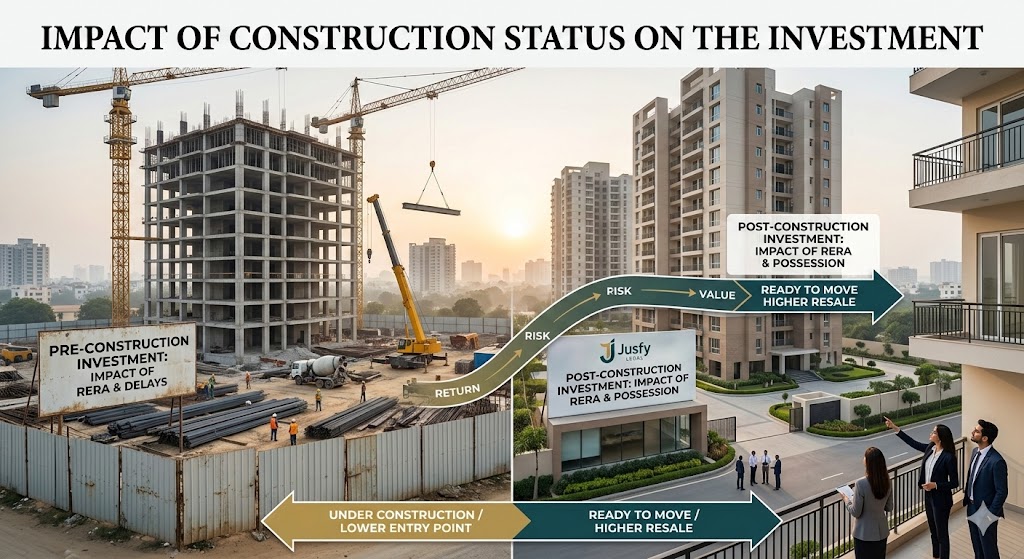
Purchasing a ‘Dream Home’ is one of the biggest achievement of our life. Buying a home for many buyers means investing hard earned money for the lifetime investment. When we lookout for buying a dream home, we often come across few choices whether to buy a ‘ready to move in apartment‘ or ‘under construction property‘ or in a property where ‘construction has not even started’, in back of our mind one constant question keeps triggering “Is this a right decision”, so to pull you out of this dilemma, in this article we have discussed various benefits and risks related to the different stages of construction.
So lets understand from the construction prospects, what are these three choices:
- Ready to move in property, where the construction is fully completed and is ready for occupation;
- Under construction property, where on the construction site, the foundations are laid, started building the structure, yet long way to be completed.
- Construction not begun, where the project site is a vacant piece of land, except the compound walls there is no construction in existence.
For you to make a wise decision, don’t just get carried away with attractive brochures, discounted rates, rather apply and analyse the pros and cons of these phases, as real estate market is one of those place where we can earn high profits as well as incur huge losses.
10 Criteria for Comparative Analysis:
| Sl. No. | Criteria | Ready to Move in | Under construction Property or Construction not begun |
| 1 | You buy what you see | You get the exact look and feel of the property, which makes it very easy for the buyer to take a decision. | Your entire property buying is on trust, you only get to see the floor plan, the model apartment and hence based on the reputation of the builder, you make decision to buy. So the look and the feel component is entirely missing. Later upon possession, if it doesn’t match your expectation, you will hardly have any choice then to compromise.
|
| 2 | Floor Plan Design and Specifications | There is no scope of doing any structural modifications. | For the apartment or villa, where construction has not yet begun, the buyer has a choice to get it customized and change specifications as per its requirement.
|
| 3 | Pricing | The prices are on the current market price, which will be high as compared to any under construction project, in future also the appreciation value will not rise much.
| The pricing as compared to the ready is low, so the appreciation value is also high.
|
| 4 | Payment Schedule | The payment is to be made at two or three trenches, like you pay some token amount, then twenty percent at the time of agreement to sell and later the balance sale price at one go at the time of sale deed registration. So here in this case, the payment schedule is fixed and tight and unless you have the capital to invest or you take hefty bank loan, you cannot think of this option.
| The payment schedule is in instalments, so it makes it easy for the buyer to pay as and when the demands are raised. Down the line you get two to five years depending on the progress of the construction, to make payments which will be easily doable. Also with some builders you have flexible payment plans which can ease your property buying. |
| 5 | Tax Benefits on Home Loan | Under section 80C of the Income Tax Act, the tax benefits for repayment of principal part of the home loan is allowed only after the construction is complete. | You may have availed home loan and would have started paying EMIs on the same but according to Section 24 of the Income Tax Act, if the property is still under construction, then the exemptions of Rs.1.5 lakh and Rs.1 lakh respectively, cannot be deducted from the income tax payment during construction.
|
| 6 | GST | Once the Occupancy Certificate is issued for the property, these taxes are not applicable for ready to move in property.
| For such type of property, there is an additional burden of paying GST. |
| 7 | Legal Documentation: | If you are planning to buy a fully ready to move in property you need to check whether you are buying from the builder or the investor, there may be a scenario that the builder might already have an investor or investors for the same property, which may lead to some legal issues later.
For illustration let suppose A is the builder, who has an investor B, who entered into Agreement to Sell at the time it was under construction, later on, investor B transferred his interest on the property to some other investor C by way of an Assignment Agreement, now, when the building is fully completed, the investor C wants to sell the property to the buyer. Now in this kind of scenario, the common challenges the buyer will face, that all these agreements between the builder and the investors will not be registered and no adequate stamp duty being paid, which implies though investors may claim ownership on the property, but the title of the property from the builder to these investors has not passed.
So ideally in such state, the builder should execute a sale deed in favour of the buyer wherein the investor should be made the confirming parties, as there is a likelihood that later the investors or their legal heirs may claim right over the property, which may lead to serious legal battles.
| For under construction property, in many states the builder collects eighty percent of the price only based on the Allotment Letter, which is again legally not sound. Always remember to make payments on the document where in properly the terms and conditions are captured, where proper stamp duty being paid. Such document has the sanctity of law and can be enforced against the builder. |
| 7 | Possession | Once sale deed is executed the possession is immediately delivered. | Its rare scenario that the project completes on time, the duration of possession is fixed on the Agreement to Sell/Construction, but yet again due to delay in construction, there is a long wait, so after investing the entire amount the delivery of actual possession depends upon your sheer luck.
If your project gets delayed for two to six years then the low pricing for which you opted for the under construction property may not be beneficial, as you need to be mindful of the EMI’s and the loss of rentals.
|
| 8 | Rentals | If you already own a home and you have bought this property for the investment purpose, then the ready to move in apartment can be rented out, the rentals accrued can be paid for the bank EMI’s, in this way the Ready to move shall be a lucrative option.
| If you are staying in the rented premises, then get ready to face the double expenses, as your rental will be clubbed with the monthly EMI’s. Further if the project gets delayed, then it will add on to your financial difficulties.
|
| 9 | Building Bye Laws and statutory compliances | For ready to move in, you have the clear picture of the property, whether there is proper sanctioned plan for your building, occupancy certificate, betterment charges, proper khatha/mutation document etc. | As mentioned earlier, the entire property purchase is on the trust. To give you a typical example the builder has taken advances for the 13th Floor, thought the plan approval was for only 10th floor, the advances towards 13th floor paid by the buyer was only on the premises that the builder will also obtain permission for the 13th floor, which later on never got sanctioned. So your entire investment can go in the soup.
It is also the common scenario in other states that once the construction starts the builder deviates from the building regulations and norms, for such reasons the Completion or Occupancy Certificates are denied, and the building may not be a legally approved, later which has its dire consequences.
|
| 10 | Litigation | For the property which is fully completely and ready to be occupied are less prone to litigations. Still you need to be careful, as whether such property which you intend to buy is not sold or agreed to be sold to others. | It has become the prevailing practice that as soon as the compound walls are built and the foundation work kick starts, the litigation suit pops up and if any stay on the construction is granted, then the entire project gets delayed. In such a scenario, to remain protected is to take proper indemnities for the financial losses incurred due to litigation, are to be born by the builder alone. |
Compared to all the preference, ready to move in property is very secure, as possession will be given immediately and quality can be verified before you purchase, but when you compare with the price and the payment schedule, under construction is much flexible and easily payable.
As a buyer it is important that along with financial and legal aspects, you should also check the builder’s capacity, past projects, performance, delivery records, builder’s website and feedback of other customers etc., even if the project gets delayed, at least there is a surety in getting your apartment. So take your own time and take good decision, because at the end of the day its your own hard earned money.